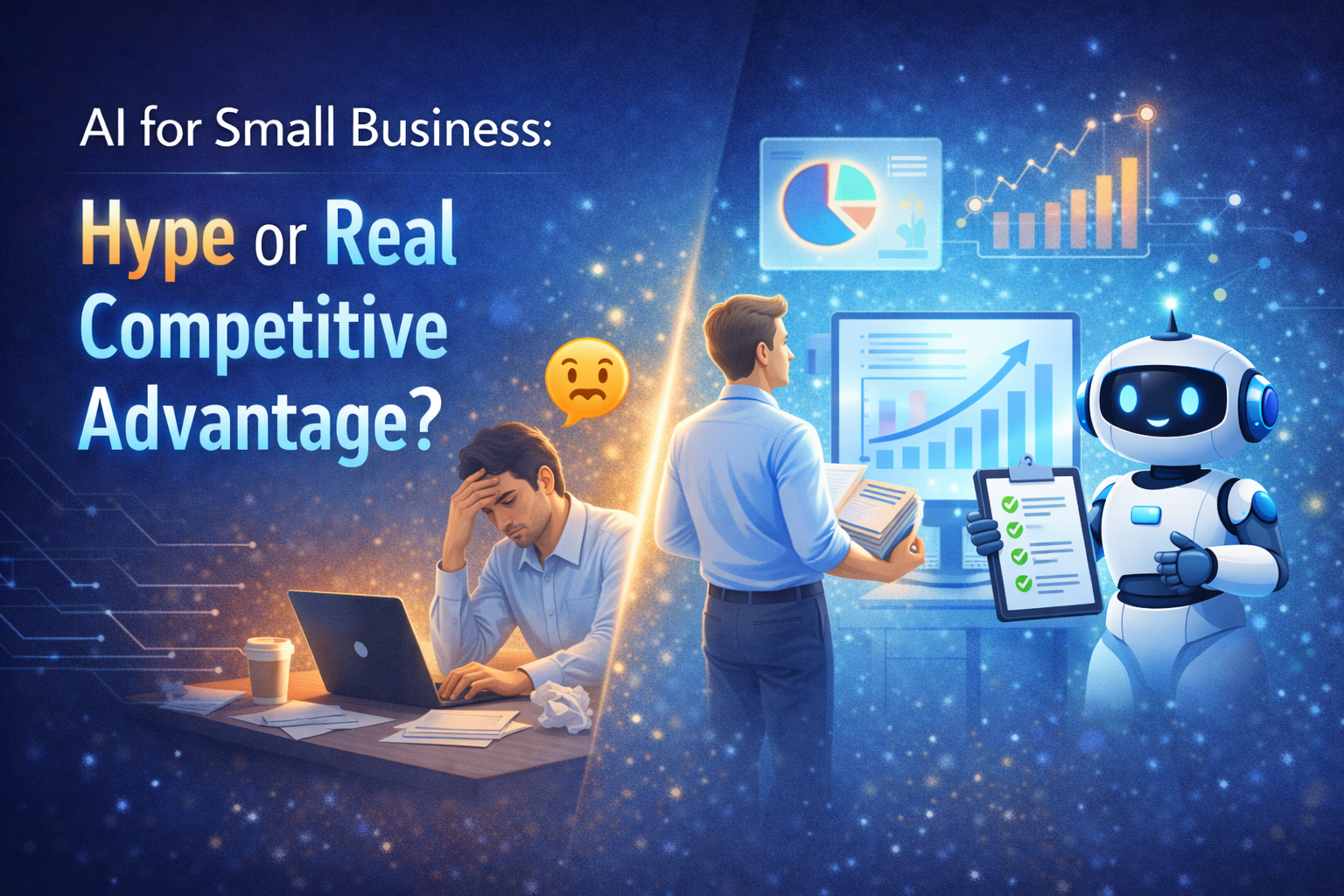
Artificial intelligence is everywhere in 2026. It appears in headlines, sales pitches, webinars and LinkedIn posts. For many Australian small business owners, the reaction sits somewhere between curiosity and scepticism. Is AI genuinely transformative, or is it simply the latest tech wave being oversold?
The honest answer is that AI is both overhyped and underestimated at the same time. It is overhyped when presented as a magic solution that will automatically grow revenue. It is underestimated when dismissed as irrelevant to small businesses with limited budgets and lean teams. The reality lies in how it is implemented.
Why the Hype Exists
AI generates hype because it promises leverage. It claims to write content, analyse data, respond to customers, generate leads and optimise marketing campaigns with minimal human input. That is an attractive proposition in any market, especially when labour costs are rising and margins are tightening.
Technology vendors amplify this promise. They showcase dramatic case studies, rapid gains and exponential growth stories. What often goes missing is context. Large enterprises with mature systems, structured data and dedicated teams experience AI differently from a small plumbing business in Perth or a local accounting firm in Subiaco.
The danger of hype is not that AI is useless. It is that expectations become unrealistic. When tools are implemented without strategy, they create confusion rather than advantage.
The Real Question: What Creates Competitive Advantage?
Competitive advantage for a small business is not about using the newest technology. It is about doing a few things consistently better than competitors. That might mean responding faster to enquiries, understanding customer behaviour more clearly, managing cashflow more predictably or delivering a smoother service experience.
AI contributes to competitive advantage when it improves one of those measurable outcomes.
For example, if AI shortens your lead response time from 24 hours to 5 minutes, that is not hype. That directly influences conversion rates. If AI-powered reporting identifies that 70% of your profitable clients come from one specific channel, that shifts marketing spend with clarity rather than guesswork. If workflow automation reduces administrative workload by ten hours a week, that frees capacity for growth.
Competitive advantage emerges when AI reduces friction inside the business.
Where AI Delivers Genuine Value
For most Australian SMBs, the strongest early wins come from automation and structured data use rather than advanced machine learning experiments.
Customer communication is a prime example. AI systems can categorise enquiries, draft tailored replies and schedule follow-ups automatically. This does not replace human judgement; it ensures consistency. Many small businesses lose opportunities simply because no one had time to respond promptly.
Marketing analysis is another area where AI creates clarity. Instead of relying on surface metrics such as clicks or impressions, AI tools can connect advertising spend to actual revenue patterns. This reduces wasted budget, which is particularly important for cost-sensitive businesses.
Operational workflows also benefit. Invoice reminders, stock notifications, job scheduling adjustments and reporting summaries can be handled with minimal manual intervention. These improvements are rarely glamorous, but they compound over time.
The competitive edge does not come from saying you use AI. It comes from running a tighter operation.
Where AI Becomes Hype
AI becomes hype when it is layered onto a weak foundation. If a business has inconsistent processes, fragmented data and unclear goals, adding AI does not fix those problems. It often magnifies them.
For example, generating more marketing content with AI will not improve results if there is no clear positioning or conversion strategy. Installing chatbots will not increase sales if the underlying service model is slow or unreliable.
AI amplifies structure. It does not replace it.
Another common misconception is that AI automatically reduces costs. While it can reduce labour hours in specific processes, implementation still requires time, integration and oversight. Treating AI as a shortcut to avoid thinking strategically usually leads to disappointment.
The Australian Context
In Australia, small businesses operate in a high-cost environment. Wages, compliance requirements and operational expenses are significant. This makes efficiency improvements more valuable.
At the same time, many SMBs compete with larger national brands or digital-first competitors. Those competitors are already investing in automation and analytics. Ignoring AI entirely may not cause immediate damage, but over time it can widen the operational gap.
The key shift for Australian small businesses is not to chase every AI tool available. It is to adopt AI selectively in areas where it improves speed, clarity or consistency.
Used wisely, AI helps smaller teams perform like larger ones. Used carelessly, it becomes an expensive distraction.
A Practical Perspective
The sensible approach is incremental. Identify one bottleneck that consumes disproportionate time or creates revenue leakage. Automate that process. Measure the outcome. Then move to the next friction point.
This mindset reframes AI from a trend to a toolset. It becomes part of infrastructure rather than a marketing headline.
Small businesses that treat AI as infrastructure gradually build systems that scale. Those that treat it as hype tend to jump from tool to tool without building depth.
So, Hype or Competitive Advantage?
AI is hype when it is adopted reactively, without clarity on what problem it solves. It becomes a competitive advantage when it is aligned with business fundamentals: faster response, smarter decisions, reduced waste and scalable systems.
For Australian small businesses in 2026, the real risk is not adopting AI blindly. It is ignoring structural efficiency while competitors quietly optimise theirs.
AI will not replace good management. It will not compensate for poor strategy. But when applied deliberately, it strengthens operational resilience and unlocks capacity that small teams often lack.
In that sense, AI is not a magic wand. It is a multiplier. And multipliers, used carefully, create real advantage.